


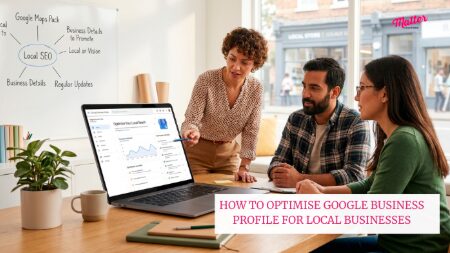
Google Business Profile optimisation means verifying ownership, completing every detail, and staying active with regular updates to boost your visibility in local search. It sounds simple enough, but most local businesses set it up once and never touch it again.
You might be wondering why your competitors keep showing up in the Map Pack while you don’t. In most cases, it comes down to a few fixable issues: an incomplete listing, inconsistent business details, or a profile that’s gone stale.
At Matter Solutions, we work with local businesses across Australia on local SEO, and this is one of the most common problems we see. This guide walks you through exactly what to fix.
What Does Google Business Profile Optimisation Involve?
Google Business Profile optimisation involves six core areas: your business category, NAP details, business description, services, photos, and regular post updates. Most businesses get the basics done and stop there, which is why so many profiles underperform.
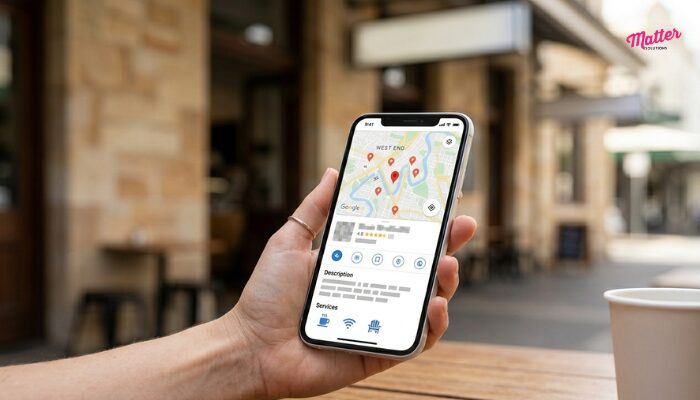
Here’s what most guides won’t tell you. Beyond your profile’s existence, Google looks at completeness, consistency across the web, and recent activity. However, a profile with missing services, no photos, and zero posts in three months sends a clear signal, and not a good one.
In our work with Australian businesses, the most skipped sections are attributes, services, and the business description. These three alone can determine whether your business appears in local search results for the right searches or not at all.
How to Set Up Your Business Information So Google Trusts You
Set up your business information accurately, and make sure Google has everything it needs to match you with the right local searches. Two areas drive the most impact here: your business category and your NAP details.

Choose the Right Business Category
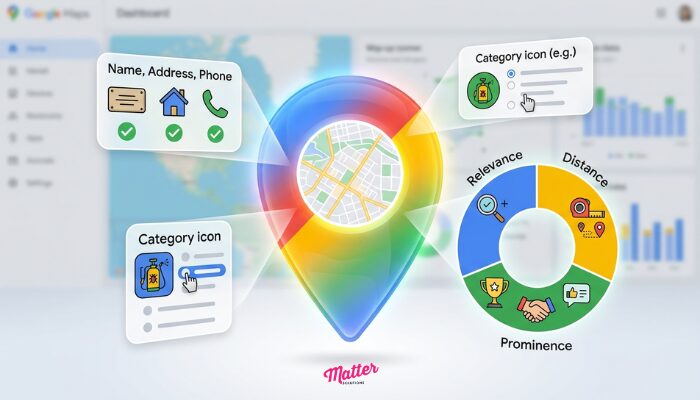
Your primary category is the strongest signal Google uses to match you to your area. It tells Google what your business is at its core, so choosing something too broad costs you ranking positions.
For example, a pest control company that selects “home services” instead of “pest control service” will consistently lose ground to a competitor who picked the specific category. Once your primary category is locked in, you can add secondary categories to capture related searches without diluting your primary relevance.
Keep Your NAP Consistent Everywhere
NAP stands for name, address, and phone number, and it needs to match across your website, Google Business Profile, and every directory your business appears in.
When your details conflict across platforms, Google loses confidence in your listing. If three different sources list three different phone numbers for your business, Google has no reliable way to confirm which one is correct. That uncertainty hurts your local search rankings directly.
Inconsistent NAP is one of the most common local SEO mistakes we see, and it is one of the first things we check when a client’s profile is underperforming.
What Improves Your Google Maps Ranking?
Google Maps ranking is determined by three factors: relevance, distance, and prominence.
Ever wondered why some businesses in your area dominate the Map Pack while others with better services barely show up? It almost always comes down to how well a profile performs across these three areas.
Here is what each one means for your profile:
- Relevance: Google looks at how well your profile matches a given search query. A complete profile with accurate categories, services, and a detailed business description gives Google more signals to work with when deciding whether you are the right result.
- Distance: This one is largely outside your control, as it refers to how close your business is to the person searching. That said, having a verified address and clearly defined service areas helps Google place you accurately in local search results.
- Prominence: Think of this as how well-known and trusted your business is online. Reviews, local citations, quality backlinks, and an active profile all contribute here. The more consistently you build these signals, the stronger your position in local search rankings over time.
If you are not seeing results, one of these three areas is almost certainly where the gap is. According to Google’s local ranking guidelines, prominence is the hardest factor to build quickly. It takes consistent effort, but it is also where the most important ranking gains come from.
How Post Updates, Photos, and Reviews Drive More Local Leads
Post updates, photos, and reviews to drive more local leads by keeping your profile active and giving Google consistent signals that your business is legitimate and worth ranking. This section covers the two areas that deliver the most visible results: what you post and how you handle reviews.
Post Updates and Photos That Work for Local Search
If you have not posted in weeks or ever, Google sees that as a sign of inactivity. Google Posts appear directly on your profile and keep your listing active in local search results. We recommend aiming to post at least once a week. This can be a service update, a seasonal offer, or a quick tip relevant to your industry.
Photos also carry equal weight. High-quality photos of your team, location, and work give potential customers a reason to choose you before they even visit your site. Add new photos regularly as well, rather than uploading a batch once and leaving it at that.
How to Get Reviews and What to Do With Them
Reviews build trust with people nearby and strengthen your prominence in local search rankings. The simplest way to build review volume is to ask satisfied customers directly after a positive experience. Most people are happy to leave a Google review if you ask at the right moment.
Responding to every review is just as important as collecting them. Based on our firsthand experience, businesses that respond to both positive and negative reviews build stronger trust with potential customers than those that ignore feedback.
When responding, use your location and service keywords naturally, as your response is indexed by Google and contributes to your local SEO relevance over time.
Take Control of Your Local Search Presence
Now that you know what goes into a well-optimised Google Business Profile, your next step is making sure everything is working together smoothly. In fact, a complete profile, accurate business information, and regular activity compound over time. Businesses that maintain this consistently pull ahead of competitors who set up their profile once and walk away.
Covering the basics is a start. But active, ongoing management is what separates businesses that dominate your area results from those that stay invisible.
If you want to stop guessing and start seeing movement in local search, Matter Solutions can help. We work with local businesses across Australia on local SEO strategies built around real results, not vanity metrics.
Get in touch to talk through what is holding your profile back.