



The struggle of the modern undergraduate student isn’t just about finding the right information; it’s about deciding what to keep and what to discard. In the humanities, particularly in history, writers often find themselves trapped between the pressure of a looming word count and the sheer volume of data they’ve uncovered.
This creates a fundamental tension: how do you prove a complex argument without overwhelming the reader—or falling short of the required depth?
The answer lies in understanding evidence density. This isn’t just about how much you write, but how much “weight” each sentence carries. In history, every claim requires a foundation of primary or secondary sources. When the evidence is dense, the essay naturally expands.
Navigating this complexity requires more than just good grammar; it requires a strategic approach to historiography. Many students find that utilizing a specialized history essay writing service helps them understand how to prioritize these sources, ensuring that the evidence density serves the argument rather than burying it.
The Anatomy of Evidence Density
Evidence density refers to the ratio of analytical claims to supporting data within a paragraph. In a high-quality academic paper, you aren’t just listing facts; you are synthesizing them.
- Low Density: Broad generalizations with little specific backing (e.g., “The Industrial Revolution changed lives.”).
- High Density: Specific data points woven into a narrative (e.g., “The shift to steam power in Manchester textile mills between 1830 and 1850 resulted in a 40% increase in output but a documented 15% decrease in life expectancy for laborers.”).
When your evidence is high-density, your essay requires more “real estate.” You need space to introduce the fact, cite the source, explain its relevance to your thesis, and transition to the next point. If you try to force a high-density argument into a short word count, the writing becomes “staccato”—choppy and difficult to follow.
The Disciplines of Detail: Why History is Unique
History is an additive discipline. Unlike a lab report where a single result might prove a point, history relies on the accumulation of perspectives. To prove that a specific event occurred due to socioeconomic factors, you might need to cite census data, personal journals, and economic decrees.

Each of these sources adds words. This is why history assignments are traditionally longer than those in the social sciences or business. You are not just reporting; you are reconstructing a world.
Managing the “Scope-to-Space” Ratio
One of the most common questions students ask during the drafting phase is about the physical constraints of their work. If you are writing a deep dive into the political nuances of the Roman Senate, you cannot do it justice in 500 words. Conversely, a simple reflection paper shouldn’t drag on for 3,000.
Determining the “right” size is a skill. According to the academic experts at MyAssignmenthelp, understanding how long is an essay depends heavily on the level of evidence density required by your specific prompt. For instance, an argumentative research paper typically demands more length than a descriptive summary because the “evidence-to-explanation” loop must be repeated for every sub-point.
Standard Essay Expectations by Evidence Type
| Essay Type | Typical Word Count | Evidence Density Level | Primary Focus |
| Narrative/Reflective | 500 – 1,000 | Low | Personal experience and subjective insight. |
| Expository | 1,000 – 1,500 | Medium | Explaining a concept with 3-5 key sources. |
| Argumentative | 1,500 – 3,000 | High | Debating a topic using extensive peer-reviewed data. |
| Research/Thesis | 3,000+ | Very High | Original synthesis of primary and secondary archives. |
The Danger of “Fluff” vs. The Necessity of Nuance
Undergraduate students often confuse “length” with “insight.” When a student sees they are 500 words short of a deadline, the instinct is to add adjectives. This is “fluff.”
True academic nuance, however, comes from deepening the evidence. Instead of saying “The king was very powerful and very influential,” a student practicing evidence density would say, “The king’s power was codified through the Edict of 1614, which effectively neutralized the regional nobility’s ability to levy independent taxes.” The second sentence is longer, but every word is doing work.
Strategic Structuring: The “PEEL” Method
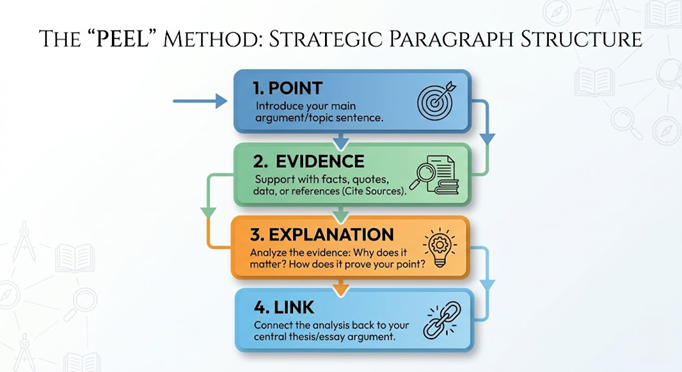
To maintain a high-ranking, readable tone that Google’s algorithms recognize as “helpful content,” you should follow the PEEL structure in every paragraph:
- Point: Start with a clear topic sentence.
- Evidence: Provide the “density”—the facts, dates, or quotes.
- Explanation: Why does this specific piece of evidence matter?
- Link: Connect this paragraph back to your central thesis.
This structure ensures that you never write “dead weight.” It forces you to justify the length of your essay through the quality of your evidence.
Why Contextual Length Matters for Ranking
From an SEO and readability perspective, Google prioritizes content that answers a user’s intent comprehensively. If a student searches for “History of the Cold War” and finds a 300-word article, they leave immediately because the evidence density is too low for the topic’s complexity.
Long-form content (1,200+ words) tends to rank better because it allows for the inclusion of semantically related terms, diverse perspectives, and thorough explanations that provide “Information Gain.”
FAQ: Common Questions on Essay Length and Evidence
Q: Can an essay be too long if I have a lot of evidence? A: Yes. Length should always be dictated by your thesis. If your evidence is repetitive or doesn’t directly support your main argument, it becomes “noise” rather than “density.” Always prioritize the strongest 3-4 points over 10 weak ones.
Q: How do I know if my evidence density is too low? A: Read your paragraph aloud. If you find yourself making claims (e.g., “Most people felt…”) without providing a specific example or citation, your density is low. Aim for at least one specific piece of evidence per 150 words.
Q: Does every paragraph need a citation? A: In a history or research-based essay, almost every body paragraph should contain at least one citation. Paragraphs that are purely your own opinion are rare in high-level academic writing unless they are part of the introduction or conclusion.
Q: Is there a penalty for going slightly over the word count? A: Most universities allow a 10% margin (over or under). However, if you are significantly over, it usually suggests a lack of editing. High evidence density doesn’t mean “keep everything”; it means “make every word count.”
Conclusion: The Balance of Power
The hallmark of a great writer is the ability to match the scope of their argument to the space they are given. By focusing on evidence density, you move away from the “word count trap” and toward a model of writing that is authoritative, engaging, and valuable.
Whether you are analyzing a historical revolution or a modern economic trend, remember that your length is not a goal—it is a byproduct of your depth.
About The Author
I’m Alexander Anderson, a senior academic consultant and content strategist at MyAssignmentHelp. With over a decade of experience navigating the complexities of higher education, I specialize in helping students bridge the gap between rigorous research and impactful storytelling.